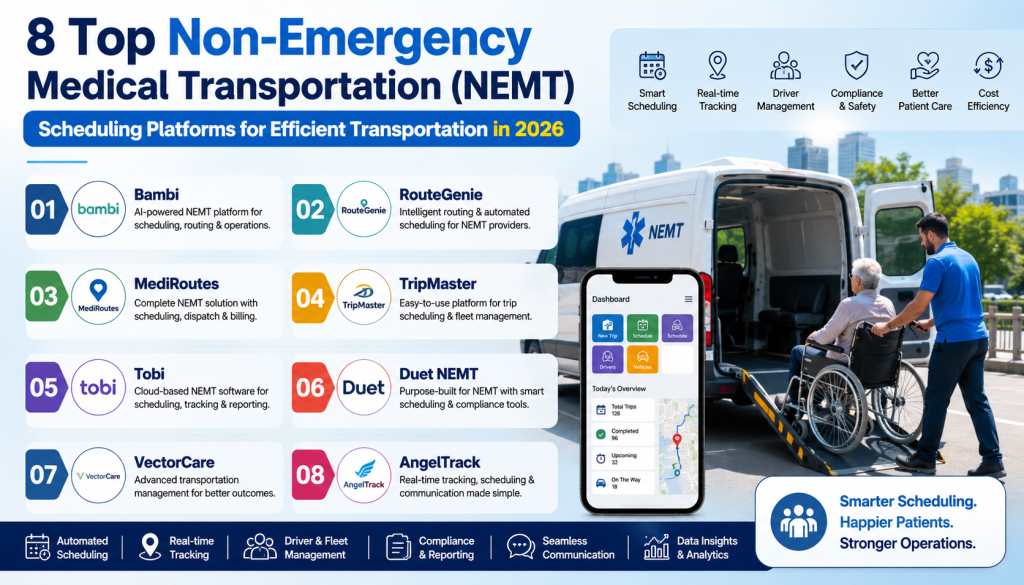
Non-Emergency Medical Transportation (NEMT) plays an important role in helping people reach medical appointments, treatment centers, rehabilitation facilities, hospitals, and other healthcare destinations. Unlike ordinary transportation services, NEMT providers often need to accommodate recurring appointments, wheelchair-accessible vehicles, mobility requirements, strict pickup windows, and specialized driver assignments.
Managing all of these requirements manually can quickly become complicated. NEMT scheduling software gives transportation providers a centralized way to organize trips, assign drivers, manage vehicles, optimize routes, and monitor transportation operations.
The best NEMT platforms can also connect scheduling with dispatching, billing, driver communication, reporting, and broker integrations. Here are eight platforms transportation providers can consider in 2026.
1. Bambi
Bambi is an NEMT-focused scheduling and dispatch platform designed to simplify transportation operations. The platform combines scheduling, dispatching, routing, billing, reporting, and driver management into one environment.
One of its main advantages is automation. Instead of requiring dispatchers to manually organize every trip, automated scheduling tools can help match transportation requests with available drivers and vehicles.
Bambi also supports broker and health-plan workflows, which can be important for NEMT companies receiving a large number of transportation requests from external organizations.
For small and midsize transportation providers looking for a modern NEMT-specific solution, Bambi can be an option worth evaluating.
2. RouteGenie
RouteGenie is an all-in-one NEMT software platform covering scheduling, routing, dispatching, and billing. Its tools are designed specifically around the challenges faced by medical transportation providers.
The platform can help dispatchers organize trips and assign drivers and vehicles according to operational requirements. Route optimization can also help providers create more efficient schedules when several trips need to be handled during the same period.
Another advantage is its billing functionality. Connecting completed transportation trips with billing workflows can reduce administrative work and help providers maintain consistent records.
RouteGenie may be especially useful for growing NEMT businesses that want multiple transportation-management functions within a single platform.
3. MediRoutes
MediRoutes is an established NEMT software solution that brings scheduling, dispatching, billing, and transportation management together.
The platform is designed to help transportation providers handle passenger reservations and coordinate daily operations while maintaining better visibility into drivers and vehicles.
MediRoutes can be useful for organizations managing recurring medical transportation, multiple vehicles, and broker relationships. Its broader feature set makes it suitable for providers that need more than basic calendar-based scheduling.
4. TripMaster
TripMaster is a transportation management platform used by NEMT providers as well as paratransit and demand-response transportation organizations.
Its scheduling tools can help providers manage reservations, recurring trips, vehicles, and drivers. The platform also includes dispatching, routing, billing, reporting, and driver communication capabilities.
One advantage of TripMaster is its broader transportation focus. Organizations that operate several types of passenger transportation services may be able to manage those activities through one system.
5. Tobi
Tobi is an NEMT scheduling and dispatch solution designed to help providers coordinate transportation requests, drivers, vehicles, and routes.
Its platform includes tools for scheduling and dispatching while providing greater visibility into active transportation operations. Features such as tracking and geofencing can help dispatchers understand where vehicles are during active trips.
Tobi may be a suitable choice for transportation providers that manage larger fleets or need connections with transportation brokers and external systems.
6. Duet NEMT
Duet NEMT provides software specifically designed for non-emergency medical transportation companies. Its platform combines scheduling, dispatching, billing, driver management, and broker-related workflows.
A notable aspect of Duet is its focus on both transportation management and business growth. Its tools are designed to help providers manage current trips while improving their ability to handle additional transportation volume.
For NEMT companies looking for scheduling software with additional communication and business-management capabilities, Duet can be worth considering.
7. VectorCare
VectorCare is a healthcare transportation management platform focused on coordinating patient transportation between healthcare organizations and transportation providers.
Rather than concentrating solely on vehicle scheduling, VectorCare addresses broader healthcare transportation workflows. Organizations can use transportation coordination tools to manage requests and connect healthcare teams with transportation providers.
Its healthcare-oriented approach can make it particularly relevant to hospitals, healthcare networks, payers, and organizations coordinating transportation across multiple providers.
8. AngelTrack
AngelTrack is a medical transportation software platform that connects scheduling with dispatching, crew management, routing, billing, and operational workflows.
The platform can help transportation teams coordinate drivers and vehicles while maintaining information needed by dispatchers throughout the day.
Its broader operational capabilities may make it useful for organizations that want scheduling connected to workforce management and dispatch rather than using a standalone scheduling application.
9. Ryde Central
Ryde Central is a patient transport platform built specifically for hospitals, NEMT providers, and ambulance services.
Its scheduling engine can automatically determine the correct transport level and generate payer-specific documentation at booking, reducing the manual work dispatchers usually handle by phone. The platform also covers dispatch coordination, tiered vendor management, and invoicing automation.
Ryde Central may be a strong option for NEMT providers focused on reducing reimbursement denials and scaling hospital partnerships without adding administrative headcount.
Important Features to Compare
Choosing an NEMT scheduling platform requires looking beyond the basic ability to create appointments. Transportation providers should consider how each system handles the complete transportation process.
Automated Scheduling
Automation can reduce the amount of manual work required to assign drivers and vehicles. Look for software that can consider availability, passenger requirements, recurring trips, and appointment times.
Route Planning
Efficient routes can help reduce unnecessary mileage and improve vehicle utilization. Providers should evaluate whether the software can handle multiple stops and transportation constraints.
Driver Applications
A mobile driver application can give drivers access to schedules and trip information while allowing them to update trip statuses and communicate with dispatchers.
Broker Connectivity
Broker integrations are important for many NEMT companies. Direct connections can reduce repetitive data entry and make it easier to receive and manage transportation requests.
Billing
A platform that connects completed trips with billing can simplify administrative processes and reduce the need to enter the same information multiple times.
Conclusion
Efficient scheduling is at the heart of a successful NEMT operation. The right software can help providers coordinate passengers, drivers, vehicles, routes, and administrative processes from a centralized system.
Bambi offers an NEMT-focused approach with automation, while RouteGenie combines scheduling with routing and billing. MediRoutes and TripMaster provide broader transportation management capabilities, while Tobi focuses on scheduling, dispatching, and transportation visibility. Duet NEMT combines scheduling with business-oriented tools, VectorCare emphasizes healthcare transportation coordination, and AngelTrack connects scheduling with broader medical transportation operations.
Before selecting a platform, transportation providers should compare fleet size, trip volume, scheduling complexity, broker requirements, billing needs, and driver workflows. A platform that fits the organization’s specific needs can make NEMT transportation more organized and efficient throughout 2026.