How Physical Movement Transforms Brain Structure and Neurochemistry
The brain, often considered the body’s most complex organ, is remarkably adaptive and responsive to physical activity. Far from being static, our brains undergo dynamic changes in response to exercise, impacting everything from the birth of new cells to the efficiency of neural communication. This intricate relationship between physical movement and brain function forms the bedrock of long-term cognitive health.
Neurogenesis, Angiogenesis, and Growth Factors
At the cellular level, exercise initiates a cascade of biological processes that are profoundly beneficial for the brain. One of the most remarkable is neurogenesis, the creation of new brain cells. This process is particularly active in the hippocampus, a brain region critical for learning and memory. Physical activity significantly amplifies adult neurogenesis, leading to the integration of these newly formed neurons into existing brain networks, enhancing overall brain function.
This cellular renewal is supported by an increased production of vital growth factors, including Brain-Derived Neurotrophic Factor (BDNF), Vascular Endothelial Growth Factor (VEGF), and Insulin-like Growth Factor (IGF-1). BDNF, often called “Miracle-Gro for the brain,” is crucial for the growth, maintenance, and survival of neurons, playing a key role in learning, memory retention, and cognitive flexibility. VEGF, on the other hand, stimulates angiogenesis, the formation of new blood vessels. This increase in capillary beds enhances cerebral blood flow, ensuring a richer supply of oxygen and essential nutrients to brain cells. This improved perfusion is vital for facilitating synaptic plasticity, the brain’s ability to strengthen or weaken connections between neurons, which is fundamental for learning and memory formation.
Preserving White Matter and Cerebral Myelination
Beyond the growth of new cells and blood vessels, exercise also plays a critical role in preserving the structural integrity of the brain. A key component of this is maintaining myelin integrity. Myelin is a fatty layer that insulates axons, the long projections of nerve cells, much like the insulation around an electrical wire. This axon insulation is crucial for protecting neurons from harm and accelerating the transmission of electrical signals, enhancing processing speed and overall brain efficiency.
As we age, myelin tends to naturally decrease, contributing to a decline in cognitive function. However, research indicates that lifelong physical activity can prevent this deterioration. Studies have shown a strong correlation between cardiorespiratory fitness, often measured by VO2max, and the amount of myelin in the brain. Even small improvements in VO2max can lead to significant boosts in brain myelin, particularly in individuals aged 40 and older. This preservation of white and gray matter volume, observed in those who engage in regular aerobic fitness training, directly correlates with improved neuronal conduction velocity and cortical activation, bolstering the brain’s structural connectivity and resilience against age-related changes.
Core Pillars of Certified Brain Health Exercise Programs
To truly harness the brain-boosting power of exercise, a multifaceted approach is often most effective. Different types of physical activity engage the brain in distinct ways, offering unique cognitive benefits. By combining various modalities, we can create multimodal workouts that comprehensively support brain health, targeting different aspects of cognitive function and neural resilience.
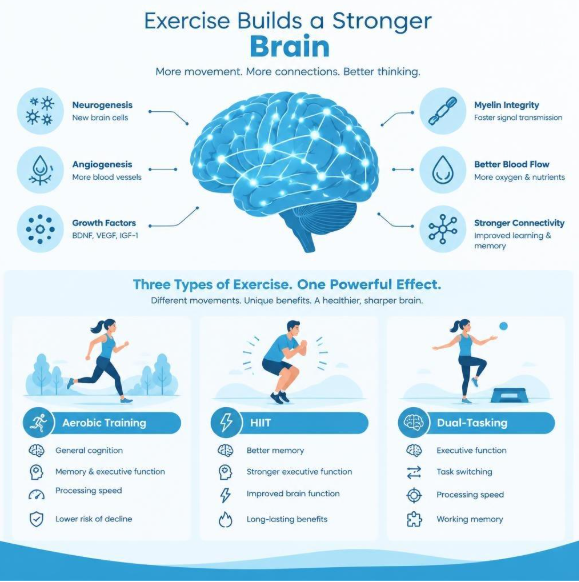
Exercise Type Primary Cognitive Benefits Key Mechanisms Aerobic Training General cognition, memory, executive function, processing speed, reduced risk of cognitive decline and dementia. Increased cerebral blood flow, neurogenesis (BDNF, VEGF, IGF-1), reduced inflammation, improved oxygen and nutrient delivery to brain, enhanced synaptic plasticity. HIIT Significant improvements in memory, executive function, overall brain function (especially in older adults). Enhanced BDNF production, improved mitochondrial function, increased cerebral blood flow, anti-inflammatory effects. Benefits can be long-lasting. Dual-Tasking Executive function, task switching, processing speed, working memory, motor-cognitive skills, attention. Challenges multiple brain regions simultaneously, strengthens neural connections, improves cognitive flexibility, requires learning and memorizing new skills. Resistance Exercise Improved memory, executive function, attentional control, protection against cognitive decline. Promotes muscle-brain crosstalk, releases myokines (muscle-derived factors) that cross the blood-brain barrier, reduces systemic inflammation, improves insulin sensitivity, supports brain structure.
Aerobic Conditioning and High-Intensity Interval Training
Aerobic exercise forms the cornerstone of any brain-healthy regimen. Activities like brisk walking, swimming, and running elevate our heart rate, improving cardiovascular health and, by extension, brain health. This increased cardiovascular efficiency leads to better cerebral blood flow, ensuring that the brain receives a steady supply of oxygen and glucose – its primary fuel. Regular aerobic conditioning also contributes to the biochemical changes discussed earlier, fostering neurogenesis and angiogenesis.
For those looking to maximize cognitive gains, High-Intensity Interval Training (HIIT) offers a potent option. HIIT protocols involve short bursts of vigorous activity followed by brief recovery periods. Research, including a 2026 study from the University of Queensland, has shown that HIIT can significantly improve brain function, particularly memory, in older adults, with these cognitive improvements potentially lasting for years even after the training program concludes. This intense form of exercise boosts cellular metabolism and stimulates the release of brain-derived neurotrophic factors more effectively than steady-state cardio alone.
Integrating Dual-Tasking into Certified Brain Health Exercise
Beyond traditional aerobic and strength training, incorporating activities that demand both physical and cognitive engagement can supercharge brain benefits. These “dual-tasking” exercises challenge our motor-cognitive skills and improve task switching abilities.
Examples include practices like Tai Chi, which combines slow, deliberate movements with mental focus and memorization of sequences. Tai Chi has been shown to enhance cognitive function, particularly executive function, in older adults due to its complex choreography. Similarly, learning dance choreography not only provides a great cardiovascular workout but also increases the brain’s processing speed and memory as we learn new steps and patterns. Even exergaming, which involves interactive video games that require physical movement, can offer notable cognitive benefits by demanding significant mental engagement alongside physical exertion. These activities force the brain to work harder, strengthening neural connections and improving cognitive flexibility.
Designing a Personalized Routine with Certified Brain Health Exercise
The most effective exercise plan for brain health is one that is tailored to individual needs, preferences, and physical capabilities. Tailored programming begins with a baseline assessment to understand current fitness levels and cognitive goals. We recommend starting gradually, perhaps with just a few minutes a day, and progressively increasing duration and intensity by five to ten minutes each week.
Incorporating a variety of exercises that include aerobic, strength, balance, and dual-tasking components will provide the most comprehensive benefits. For instance, resistance training should target major muscle groups and include activities that improve balance, agility, coordination, and flexibility. For those seeking expert guidance in developing a program specifically designed to optimize cognitive outcomes, exploring a certified brain health exercise program can provide invaluable support and structured guidance. The principle of progressive overload is key – continuously challenging the body and brain ensures ongoing adaptation and improvement. For adults aged 65 and older, specific balance training is also crucial to reduce fall risk and enhance overall coordination.
Cognitive Gains Across Diverse Lifespans and Clinical Conditions
The positive impact of exercise on brain health is not limited to a single age group or health status; it extends across the entire lifespan cognition spectrum. From developmental gains in children to mitigating decline in older adults, physical activity serves as a powerful clinical intervention for various cognitive challenges.

Enhancing Executive Function in ADHD and Youth
For children and adolescents, exercise offers significant developmental gains, particularly in areas of memory and executive function. Research from a comprehensive meta-analysis in 2026 highlighted that children and adolescents showed the greatest memory improvements from exercise. Crucially, individuals with Attention Deficit Hyperactivity Disorder (ADHD) experienced the most dramatic improvement in executive function.
Exercise provides a non-pharmacological means of enhancing cognitive performance for those with ADHD. Cardiovascular activity, for example, has been shown to improve attentional allocation and working memory in children with the condition. While the exact mechanisms are still being explored, it’s believed that exercise can influence dopamine regulation and improve neural pathways associated with focus and self-control, aiding scholastic performance and impulse control.
Mitigating Cognitive Decline and Dementia in Older Adults
As we age, concerns about brain aging and the risk of cognitive decline become more prevalent. However, consistent physical activity proves to be a formidable ally. Regular exercise significantly reduces the risk of cognitive decline and dementia, including Alzheimer’s disease. Even for individuals already experiencing mild cognitive impairment, studies have shown that initiating an exercise program can lead to improved brain function.
Exercise strengthens neural connections and builds cognitive reserve, which is the brain’s capacity to cope with damage or disease without showing symptoms. This enhanced neural resilience means the brain is better equipped to handle stressors and maintain function as it ages. Lifelong exercise, especially maintaining good cardiorespiratory fitness, helps preserve myelin, a critical factor in protecting against brain deterioration. Furthermore, High-Intensity Interval Training (HIIT) has demonstrated its ability to improve brain function in older adults, with benefits lasting for years, offering a proactive strategy for Alzheimer’s prevention and maintaining mental sharpness well into later life.
Optimal Dosage, Intensity, and Timelines for Mental Clarity
Understanding how much and what kind of exercise is needed, along with the timeline for seeing benefits, is crucial for establishing a sustainable routine. It’s not just about moving; it’s about moving effectively to support our brain health.

Weekly Physical Activity Guidelines for Cognitive Reserve
For optimal brain benefits, adults should aim for at least 150 minutes of moderate-intensity physical activity weekly, or 75 minutes of vigorous-intensity activity. This can be broken down into manageable chunks, such as 30 minutes of brisk walking five days a week, or shorter, more intense sessions. Beyond aerobic activity, resistance training is recommended two or more days a week, targeting major muscle groups.
For adults aged 65 and older, incorporating specific balance work is also vital to reduce fall risk and improve coordination. Importantly, any amount of physical activity is better than none. Even breaking up sedentary time with short bursts of movement, like taking the stairs instead of an elevator or parking further away, contributes to building cognitive reserve and maintaining overall brain health. The American College of Sports Medicine recommends a holistic approach that includes cardiovascular, strength, balance, agility, coordination, and flexibility training.
Immediate Versus Long-Term Brain Adaptations
The benefits of exercise on the brain can be felt almost immediately and accumulate significantly over time. We often experience acute alertness and improved post-exercise mood directly after a session, alongside reduced stress and anxiety. These immediate effects are due to the rapid release of neurotransmitters and improved blood flow.
For more substantial cognitive improvements, such as enhanced memory and executive function, 1-to-3-month gains are often observed with consistent intervention. However, for structural changes within the brain, such as increased brain volume and neurogenesis, a longer commitment is typically required. Research indicates that consistent moderate-intensity exercise over six months to a year is associated with an increase in the volume of selected brain regions responsible for thinking and memory. Therefore, while patience is key, the goal should always be lifelong maintenance of physical activity to ensure sustained cognitive health and neuroprotection.
Frequently Asked Questions About Exercise and Brain Health
How quickly does exercise improve cognitive function and memory?
The brain responds to exercise remarkably quickly. Immediately after a session, you might experience improved mood, reduced stress, and enhanced alertness, thanks to acute neurotransmitter release. More tangible cognitive improvements, such as better focus and memory, can often be measured within 4-week test gains of consistent moderate activity. For more profound and structural changes, like increased brain volume and neurogenesis (the growth of new brain cells), sustained exercise for about six months is generally when these benefits begin to become evident. The key is consistency, as benefits accumulate over time.
Which workout format delivers the greatest brain-boosting benefits?
While all physical activity is beneficial, a multifaceted approach often yields the best results. Aerobic fitness is foundational, enhancing cerebral blood flow and promoting neurogenesis. Dual-task complexity, found in activities like Tai Chi or dance, is excellent for improving executive function and task switching. Interval training, such as HIIT, has shown significant benefits for memory and overall brain function, particularly in older adults. A multimodal synergy combining aerobic, strength, balance, and cognitively challenging exercises provides the most comprehensive brain-boosting benefits.
Can light-intensity movement like walking effectively lower dementia risk?
Absolutely. Even light-intensity movement, such as regular daily walks, plays a crucial role in lowering the risk of cognitive decline and dementia. While moderate to vigorous activity offers more pronounced benefits, the cumulative steps and consistent engagement in even low-intensity exercise contribute significantly to vascular health, ensuring better blood flow to the brain. This improved circulation provides vital neuroprotection against age-related cognitive issues. Studies have even indicated that exercising for as little as 25 minutes a week can lead to larger brain volumes, suggesting that every bit of movement counts.
Conclusion
As we look towards October 2026 and beyond, the evidence is clearer than ever: exercise is far more than just a physical pursuit; it is a powerful and accessible strategy for lifelong wellness and brain health. From fostering new brain cells and improving neural connections to mitigating cognitive decline and enhancing mood, physical activity acts as a comprehensive wellness plan that protects our most vital organ.
By understanding the profound impact of exercise on brain structure and neurochemistry, and by embracing the recommended guidelines for duration and intensity, we can proactively cultivate neuroprotection and maintain our cognitive sharpness. Establishing behavioral consistency in our exercise routines, whether through brisk walks, challenging HIIT sessions, or cognitively engaging dual-task activities, is an investment in our future selves. This commitment to physical movement is a cornerstone of holistic vitality, empowering us to live lives filled with mental clarity, emotional balance, and sustained cognitive function.