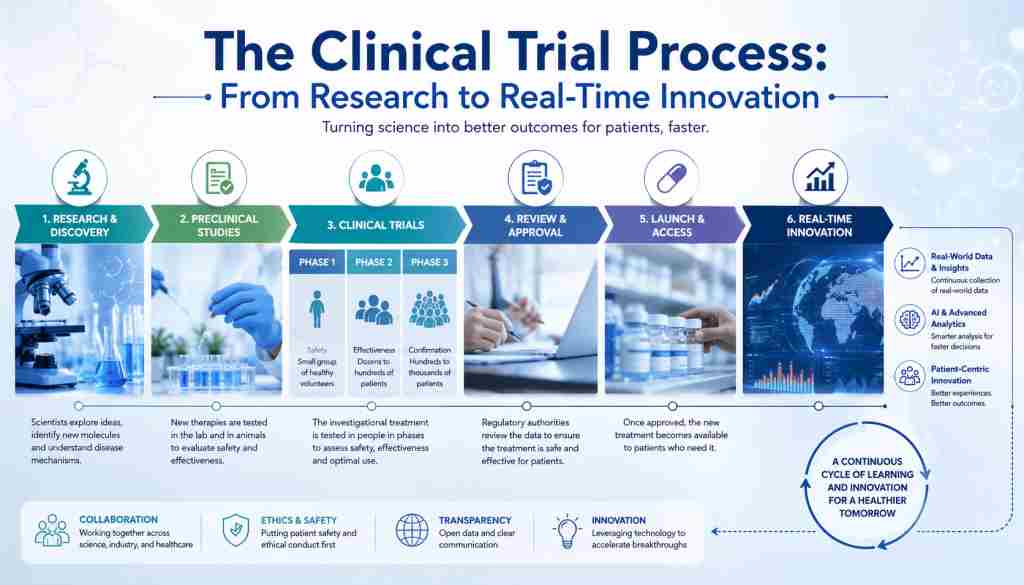
Clinical trials are fundamental in advancing medical science. They help ensure that new drugs and therapies are safe, effective, and beneficial for patients. For individuals considering participation, understanding how clinical trials work can help clarify the path from early research to broad use in patient care. If you want specific insights into what to expect during an AbbVie clinical trial, there are resources available that explain the process in detail.
The clinical trial process is designed to be rigorous, progressing through carefully regulated steps in which each phase serves unique and vital roles. Participating in a clinical trial provides early access to new treatments and is a meaningful way to contribute to scientific discovery.
Preclinical Research
The journey of every new treatment begins with preclinical research. Scientists use laboratory models, such as cell cultures and animal models, to gather initial data on a compound’s safety and biological activity. The findings from these experiments help researchers decide whether the potential benefits of a new drug or therapy warrant moving forward to human trials. Without the thoroughness of preclinical research, the risks to human volunteers in later phases would be too high.
Preclinical studies are often conducted in a stepwise manner, with repeated tests to confirm results. Different animal species may be used to better predict responses in humans, and the data collected here is crucial for drafting safe human trial protocols. Regulatory agencies carefully scrutinize preclinical findings before granting approval to proceed to human testing. This gatekeeping step ensures that only the most promising and safest candidates move forward, significantly reducing risks associated with first-in-human exposure.
Phase 0: Exploratory Studies
Phase 0 is sometimes described as the “micro-dosing” stage. In these studies, a small group of participants receives extremely low doses of a new drug. The goal is not to test effectiveness, but to better understand how the body processes the drug and how it behaves at the molecular level. This step provides critical information on how a therapy might act in larger groups, setting the stage for more extensive safety testing.
Phase 0 studies are not always mandatory, but they can speed up decision-making for drug developers. The insights gained may help eliminate unpromising candidates earlier in the development process, saving time and resources for more viable options. These early insights facilitate a seamless transition into subsequent phases and lay the foundation for which data to focus on in later trials. As a result, phase 0 can accelerate the journey from discovery to meaningful clinical results.
Phase 1: Assessing Safety
During Phase 1 trials, the new treatment is given to a small group, often 20 to 100 healthy volunteers or people with the targeted condition. At this stage, researchers focus on safety: determining the right dose, monitoring for adverse reactions, and learning about possible side effects. Only when a therapy is found to be reasonably safe do researchers move on to larger studies in patients who might directly benefit from it.
Phase 2: Evaluating Efficacy
Phase 2 studies welcome a larger group, often hundreds of participants, all living with the medical condition the treatment aims to address. The primary goal here is to determine how well the therapy works, while continuing to monitor safety. Researchers refine dosing regimens and gather more detailed information about short-term side effects or risks. Phase 2 is pivotal in establishing whether a treatment offers meaningful benefits worth pursuing in even larger groups.
Phase 3: Confirming Effectiveness
Phase 3 trials are the most extensive and often include thousands of participants across multiple locations worldwide. At this stage, the new treatment is directly compared to existing standard therapies in a randomized fashion. Phase 3 data form the basis for regulatory approval decisions, documenting effectiveness while collecting information about less common side effects and risks. The FDA and other agencies require robust Phase 3 evidence before a treatment can enter the mainstream.
Large-scale phase 3 trials are often multicenter and sometimes international in scope, ensuring greater statistical power and broader representation. The comparative structure of these studies, often using placebos or active comparators, helps clarify the real-world advantages and disadvantages of the new intervention. Data from these trials support product labeling and prescribing guidance for clinicians.
Phase 4: Post-Market Surveillance
Approval for public use does not mark the end of a drug’s testing life. Phase 4, or post-marketing surveillance, gathers vital information about a treatment’s risks, benefits, and long-term safety once it has widespread use. Ongoing data collection can lead to new usage recommendations or, in rare cases, updated warnings or withdrawals if unexpected side effects emerge. Post-market surveillance also supports the drug’s use in new patient groups and combinations.
Recent Advancements in Clinical Trials
The pace of clinical trials is accelerating due to technological and digital innovations. The FDA is now using real-time data analysis powered by AI and cloud technology, enabling immediate insights into safety signals and patient responses. This could potentially shorten the approval times for new therapies.
Leading pharmaceutical companies are participating in this initiative by implementing real-time monitoring, moving away from traditional checkpoint-based oversight to a system of continuous data streams. Additionally, including diverse patient populations in trials enhances their relevance and fairness, making the results more applicable to the general population. Efforts to increase transparency and facilitate participation are also improving patient engagement in clinical research.
Conclusion
Understanding the steps and safeguards in the clinical trial process is valuable for anyone considering joining a study or simply interested in how medical research advances. Each stage serves to protect patients while gathering essential data for regulatory review. New initiatives in real-time data analysis and wider patient inclusion are helping bring advances to patients more quickly and safely than ever before.

